History
Beagles (as a breed) have been in existence for
quite some time, although their precise origins are only vaguely
known. Beagle-type dogs are described in documents dating from
400 B.C. Greece and A.D. 200 Britain. The Romans are thought to
have transported to England small rabbit hunting hounds and bred
them with the local hounds. Talbot Hounds were brought to
England from France during the Norman Conquest in 1066 and are
considered to be ancestors to the Southern Hound, the Beagle and
the Foxhound.
Beagles became quite popular with the British
monarchy in the 1300 and 1400's. Edward II and Henry VII both
kept packs of Glove Beagles, so named since they were small
enough to fit on a glove. Elizabeth I kept packs of Pocket
Beagles which were only nine inches high at the withers.
By the 1400's Beagles existed in Britain, Italy,
Greece and France. The word "beagle" has two possible
origins. It either originates from the Celtic word "beag"
which means small or from the French word "begle"
meaning "useless or of little value".
By the 1700's two types of hounds existed for
hunting rabbits: the Southern Hound and the much quicker North
Country Beagle. Since fox hunting was becoming increasingly
popular, Beagles lost ground to the Foxhounds. Fortunately for
the continuing existence of the Beagle, farmers in England,
Ireland and Wales continued to keep hunting packs.
In the mid-1800's Reverend Phillip Honeywood
established his pack in Essex, England. This is thought to
be the progenitor of the modern Beagle. He was breeding for
hunting skills though, not looks. A fellow Englishman, Thomas
Johnson, was responsible for breeding lines of Beagles that
could both hunt and look attractive.
Beagles were imported into the United States in
1876 and accepted as a breed by the American Kennel Club in
1884.

Beagles Today
Beagles can be compared to Foxhounds (33")
and Harriers (21-25"), hounds which are similar in
structure and coloring. The American Kennel Club (AKC)
recognizes two sizes: 15" beagles and 13" beagles.
Depending on the characteristics of the
individuals, the sizes can be hard to tell apart without using a
wicket (a judge's measure)- both sizes are born into the same
litters. Although a breeder can guess, based on family
history, whether a puppy will grow to be 13" or 15",
there's no rule. Their future height may be obvious in
some pups from as young as six months, but beagles can continue
to grow until they're two years old.
Today's beagles are happy family members,
agility-certified athletes, hunting warriors, show dogs, film
stars, and hard-working
service-sniffers. Their remarkable ability to scent
well-disguised contraband makes them invaluable- you'll often
see them searching airport baggage.
Beagles are also compact, robust, breed true, and
have fairly large litters- which makes them ideal candidates for
lab experiments. Kim Basinger is well-known for her
love of beagles and her efforts to rescue them from inhumane
laboratory conditions. That said, research on beagles has
been instrumental in modern medical research and advances.
It's a small glimmer of comfort to those of us who love them
dearly.
Beagles are known for their lively, mischievous
and gentle nature. Unlike protective dogs, beagles are
accustomed to the pack and count everyone a friend; in general,
they are terrific with children. Their roots in the hunt
means they may bark, but remember that love, toys, and lots of
playtime can work miracles.
Thinking of buying a Jackpot beagle? Prepare
for a family-style life with lots of time at home, a babysitter
for emergencies, and a yard. As pack dogs, beagles are
happiest with constant contests and play. They'd love to
be part of a big, active family. Small families may
consider training one beagle and then buying a friend for his
first birthday.
Description
The AKC homepage http://www.akc.org
describes the breed standards. The English Breed Standard
follows; please note that there are some differences. Should you
require the American Standard, please contact your local breed
club or the AKC.
English
Beagle Standard (Revised 1988)
GENERAL APPEARANCE A
sturdy, compactly-built hound, conveying the impression of
quality without coarseness.
CHARACTERISTICS A
merry hound whose essential function is to hunt, primarily hare,
by following a scent. Bold, with great activity, stamina and
determination. Alert, intelligent, and of even temperament.
TEMPERAMENT Amiable
and alert, showing no aggression or timidity.
HEAD AND
SKULL Fair length, powerful without
being coarse, finer in the bitch, free from frown and wrinkle.
Skull slightly domed, moderately wide, with slight peak. Stop
well defined and dividing length, between occiput and tip of
nose, as equally as possible. Muzzle not snipey, lips reasonably
well flewed. Nose broad, preferably black, but less pigmentation
permissible in the lighter coloured hounds. Nostrils wide.
EYES Dark brown or
hazel, fairly large, not deep set or prominent, set well apart
with mild appealing expression.
EARS Long, with
rounded tip, reaching nearly to the end of nose when drawn out.
Set on low, fine in texture and hanging gracefully close to
cheeks.
MOUTH The jaws should
be strong, with perfect, regular and complete scissor bite,
i.e., the upper teeth closely overlapping the lower teeth, and
set square to the jaw.
NECK Sufficiently
long to enable hound to come down to scent easily, slightly
arched and showing little dewlap.
FOREQUARTERS
Shoulders well laid back, not loaded. Forelegs straight and
upright, well under the hound, good substance, and round in the
bone, not tapering off to feet. Pasterns short. Elbows firm,
turning neither in or out. Height to elbow about half height at
withers.
BODY Top line
straight and level. Chest let down to below elbow. Ribs well
sprung and extending well back. Short in the couplings but well
balanced. Loins powerful and supple, without excessive tuck-up.
HINDQUARTERS Muscular
thighs. Stifles well bent. Hocks firm, well let down and
parallel to each other.
FEET Tight and firm.
Well knuckled up and strongly padded. Not hare-footed. Nails
short.
TAIL Sturdy,
moderately long. Set on high, carried gaily but not curled over
back or inclined forward from the root. Well covered with hair,
especially on underside.
GAIT/MOVEMENT Back
level, firm with no indication of roll. Stride free, long
reaching in front and straight without thigh action. Hind legs
showing drive. Should not move close behind nor paddle not plait
in front.
COAT Short, dense and
weatherproof.
COLOUR Any recognized
hound colour other than liver. Tip of stern white.
SIZE Desirable
minimum height at withers 33cm (13 ins). Desirable maximum
height at withers 40cm (16 ins).
*** Please note, in the
USA, there are two recognized sizes.
13 inches (Not exceeding
13 inches at the withers.)
15 inches (Not exceeding 15 inches
at the withers.)
FAULTS Any departure
from the foregoing points should be considered a fault and the
seriousness with which the fault should be regarded should be in
exact proportion to its degree.
NOTE Male animals
should have two apparently normal testicles fully descended into
the scrotum.
Frequently Asked Questions
Are beagles easily
trained?
There is no simple answer
to this question because, like people and most other breeds of
dogs, individuals vary. However, in general, hounds are
challenging to train. Beagles are often said to "live on
their own agenda." This doesn't make training impossible,
it just means you need to find the training method that works
for your dog.
Food is often the best
motivator for beagles. The use of food in training is not
accepted by all dog trainers, so it is important to find an
instructor who understands beagles (or scent hounds in general)
and is willing to use different methods, depending on what is
effective for your beagle.
Beagles are intelligent
dogs and very good problem solvers. They can get bored very
quickly with an exercise and find another way to have fun...
which may mean teaching you to interrupt a training session for
supper.
You should count on short
training sessions *every day* for at least the first two years
of your dog's life if you want a perfectly obedient dog. There
aren't many beagles out there with Obedience titles, but there
are some, and it can be done.
If you want a dog that is
easily trained to be 100% obedient, don't get a beagle.
Are beagles easily
housebroken?
Beagles can be challenging
to train, which may (but doesn't necessarily) carry over into
house-training.
There are many methods of
house-training. Your best bet is to read up on the subject and
choose one with which you are comfortable. If your dog
doesn't respond to your favorite method, don't despair -
just try another way.
Many beagle owners find
crate-training sufficient, and it tends to solve other problems
such as destructive chewing. Crate training is fairly easy for
you and the dog, and allows you to establish a schedule that
meets your needs. Consistency and vigilance will almost always
result in a properly trained dog.
Be warned however, some
beagles take up to a year to be fully house-trained, and the odd
few are never completely reliable.
What are beagles like
with children?
Beagles generally adore
children and will play for hours with them. However, like any
breed, beagles need to be socialized properly, and should never
be left alone with young children.
Socialization and
supervision should be sufficient to make beagles the perfect
playmate, however, there are two things you should know:
First, beagles play
rambunctiously and can accidentally hurt young children. Second,
beagles tend to be "mouthy", which means they like to
play with their mouths, or chew things. This is not biting, but
grabbing things with their mouth. It is not done in anger
or fear- for beagles, it is a way to play.
Over-enthusiastic play and
"mouthiness" may be trained out of most puppies, but
it seems to be instinctive and is something that you should be
aware of when considering a beagle.
Do beagles shed? Do
they require regular grooming?
Yes, beagles shed - don't
be fooled by the short coat. However, beagle shedding is
rarely intrusive because they shed short hairs. Their coat is
actually classified as a medium length (as opposed to a
short-coated breed like the Doberman) because they have
double-coats, which include a coarse outer coat and a soft
undercoat.
Beagles generally shed more
in the Spring, as their coats tend to thicken over the winter.
This isn't necessarily due to climate. Hair growth depends on
the amount of light, not on temperature. As the days get
shorter, hair grows faster.
Beagles should be groomed
with a medium-bristle brush or a hound glove at least once a
week. This loosens and removes dead hair and allows for new hair
growth. It's also good for the skin. A product called 'Zoom
Groom' is very popular with many Beagle owners.
Beagles are fairly clean
and, as long as they aren't rolling in really-nice-dead-things,
don't require frequent baths. However, bathing helps if you are
trying to control fleas.
Beagles' hanging ears must
be checked at least every two weeks for infection and waxy
build-up. There are several great ear-wash products
available, and this doesn't need to take more than a minute.
Odors from your dog's ears
may indicate a yeast build-up or infection, and may need
stronger treatment. Other signs of ear infections include
constant head-shaking and scratching at or just below the ears.
Do beagles make a lot
of noise?
Beagles do not tend to be
'yappy' dogs, however, as hounds they are trained to sound when
they sight quarry. For some beagles, "quarry" means a
shadow, a bug, a plane, a leaf... but other beagles are very
quiet and rarely make a noise.
Most will bark or growl
when strange dogs/people/things-you-can't-see come into their
territory. They may also bark when excited, although this varies
from dog to dog.
Beagles can howl. This
alerts hunters when the beagle pack corners their prey. Again,
not all beagles will howl, but you should be prepared for the
possibility.
A third noise beagles can
make is hard to describe, kind of like a half-howl, called
baying. Beagles will often make this noise when they catch the
scent of "quarry," which was useful during the hunt.
If you want your dog to be
quiet, you can patiently train them, but it may take several
months for your dog to understand the 'quiet' command. Some
beagles never do understand that you want quiet. If quiet is a
necessity, you may want to consider another breed, or more
radical training methods such as anti-bark collars.
What colors do Beagles
come in?
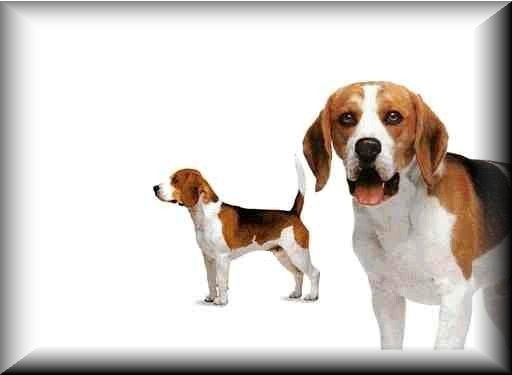
The most common color
combination is called tri-color. It means a black saddle, white
legs, chest, and belly, with a tan head, and tan around the
edges of the saddle. Many dogs have a white blaze on their face,
but a solid tan face is common too. Tri-color puppies are born
black and white - tan develops as the puppy gets older.
Red and White: There is no
black at all, and the red can range from a light tan to a darker
red. These puppies are born as red and whites, or sometimes even
a solid white, with the color developing later.
Lemon and White: The lemon
varies from an off-white, to a dark lemon. These puppies are
often born completely white, with the color developing later.
Black and White: Very rare.
With all of these colors,
you can have freckling, mottling, ticking, and grizzling.
Occasionally, an all-white hound appears, but this is very rare.
These are not albinos, simply white dogs.
Personality and
Temperament
When looking for a life companion, it is important
to understand their personality, temperament, and traits.
Temperament can generally be traced to the purpose for which a
particular group of dogs was bred.
First off, there is no difference in temperament
between the two Beagle varieties (13" and 15").
Beagles are scent hounds, bred to track prey over the
countryside. This required energetic, independent, outgoing, and
sometimes stubborn dogs who would follow a plan to it's
conclusion.
Beagles were kept in packs, resulting in a strong
need for companionship from another dog or from you. A lone
Beagle won't necessarily be underfoot, but they require
substantial playtime and attention. Without stimulation from
their 'pack', they will amuse themselves - and this can
mean trouble. Beagles can do astonishing damage!
Beagles do not make good 'outside' dogs,
especially if you only have one. Again, they need to be kept
occupied and if regularly left in a backyard, will usually dig,
bark, explore, experiment, and contemplate escape. If you
are dedicated to walking in the morning before work and spending
lots of time with them when you get home, your beagle should be
able to spend the day in a securely fenced yard. However,
most owners keep their dogs inside when they're unsupervised for
long periods. For many reasons, including risk of theft, escape,
or torment by neighborhood children and dogs, having a secure
indoor place for your Beagle is the best bet.
As stated in the frequently asked questions
section, the Beagle's independent and stubborn nature makes
obedience training a necessity and a challenge. Be sure to get
into some kind of training routine early in your Beagle's life.
If you attend obedience classes, make sure your instructor
understands the hound personality. Beagles require a firm
trainer, but not a physical one. Beagles neither respect nor
acknowledge physical force.
Beagles have loads of energy and are well-suited
to someone who likes to take long walks. Beagles can be kept in
apartments, however, you must be extremely dedicated to taking
your dog for regular walks. Bred to run cross-country in pursuit
of rabbits and foxes, they enjoy long runs. Keep in mind that
you should wait until the dog is at least a year old before
starting a running program, and you should start slowly. Talk to
your vet for more information on running with your dog.
Because Beagles were bred as a pack animal, they
generally get along well with other dogs, and often cats.
Beagles should not be aggressive towards other dogs, however,
they will protect their territory by growling and other
posturing. More often than not, your Beagle will end up playing
with rather than fighting with the intruder. Beagles should
*never ever* be aggressive towards humans. That said, due to
their intelligence and independence, they will try to dominate
you. You should not allow this and if you are having problems,
see a good dog trainer on how to correct it.
Beagles generally adore children, if they are
socialized properly with them. Small children and dogs should
never be left unsupervised, but in general, you will find that
Beagles make wonderful companions for kids and adults alike.
When looking for a Beagle, you need to be sure to
go to a reputable, responsible breeder. Beagles are one of the
top puppy-mill dogs because they produce such adorable puppies.
Dogs from puppy mills, usually those purchased in a pet store,
can be extremely timid and/or aggressive. In addition, they can
suffer from numerous health problems. Please read the following
section on genetic disorders for more in-depth information on
the problems from which poorly-bred Beagles suffer. Please also
see the section on Responsible Breeders to aid you in your
search.
Overall, Beagles are fun-loving, happy dogs. As
long as you understand the Beagle personality, they can make a
great addition to your family. One Beagle owner was heard to say
that "beagles belong in Disneyland - they are the happiest
dogs on earth."
|